


As IoT ecosystems continue to expand across industries, from smart energy and industrial automation to connected cities and mobility, one challenge remains universal: trust.
In large-scale deployments, trust cannot be based on assumptions. Devices operate for years in uncontrolled environments, communicate autonomously, and evolve continuously through software updates. Without solid foundations, IoT ecosystems become fragile, exposed, and increasingly difficult to scale.
From Identity to Control: Why PKI Alone Is Not Enough
Public Key Infrastructure is often presented as the foundation of IoT security, and rightly so. Cryptographic identities enable authentication, encryption, and secure communication at scale.
However, in real-world deployments, PKI is not a static asset. Certificates expire, keys must be rotated, devices are compromised, replaced, or retired. Without continuous governance, PKI quickly becomes a blind spot rather than a safeguard.
In large IoT ecosystems, PKI must therefore be operated, not just deployed, integrated into processes, monitored continuously, and aligned with operational realities.
Device Attestation and Control: Trust Must Be Verifiable, Not Assumed
A cryptographic identity alone does not guarantee that a device is behaving as expected.
This is where Device Attestation and Control (DAC) becomes essential. Attestation mechanisms allow platforms and operators to verify, in real time, that a device is running authorized firmware, has not been tampered with, and complies with defined security policies.
DAC (Device Attestation & Control) transforms trust into a dynamic enforceable condition:
-
Devices can be granted, limited, or revoked access
-
Firmware integrity can be enforced continuously
-
Compromised devices can be isolated automatically
Trust is no longer binary. It becomes contextual, measurable, and actionable.
Why IoT Security Must Reach the Network Operations Center (NOC)
Security that cannot be observed or acted upon is ineffective.
As IoT deployments scale, trust decisions must be integrated into the NOC, where connectivity, performance, and incidents are already managed.
By bringing identity status, certificate health, and attestation signals into the NOC, operators gain:
-
Real-time visibility on device trust levels
-
Early detection of anomalies or mass failures
-
The ability to act before security issues become service disruptions
This convergence between security and operations is a prerequisite for resilient IoT infrastructures.
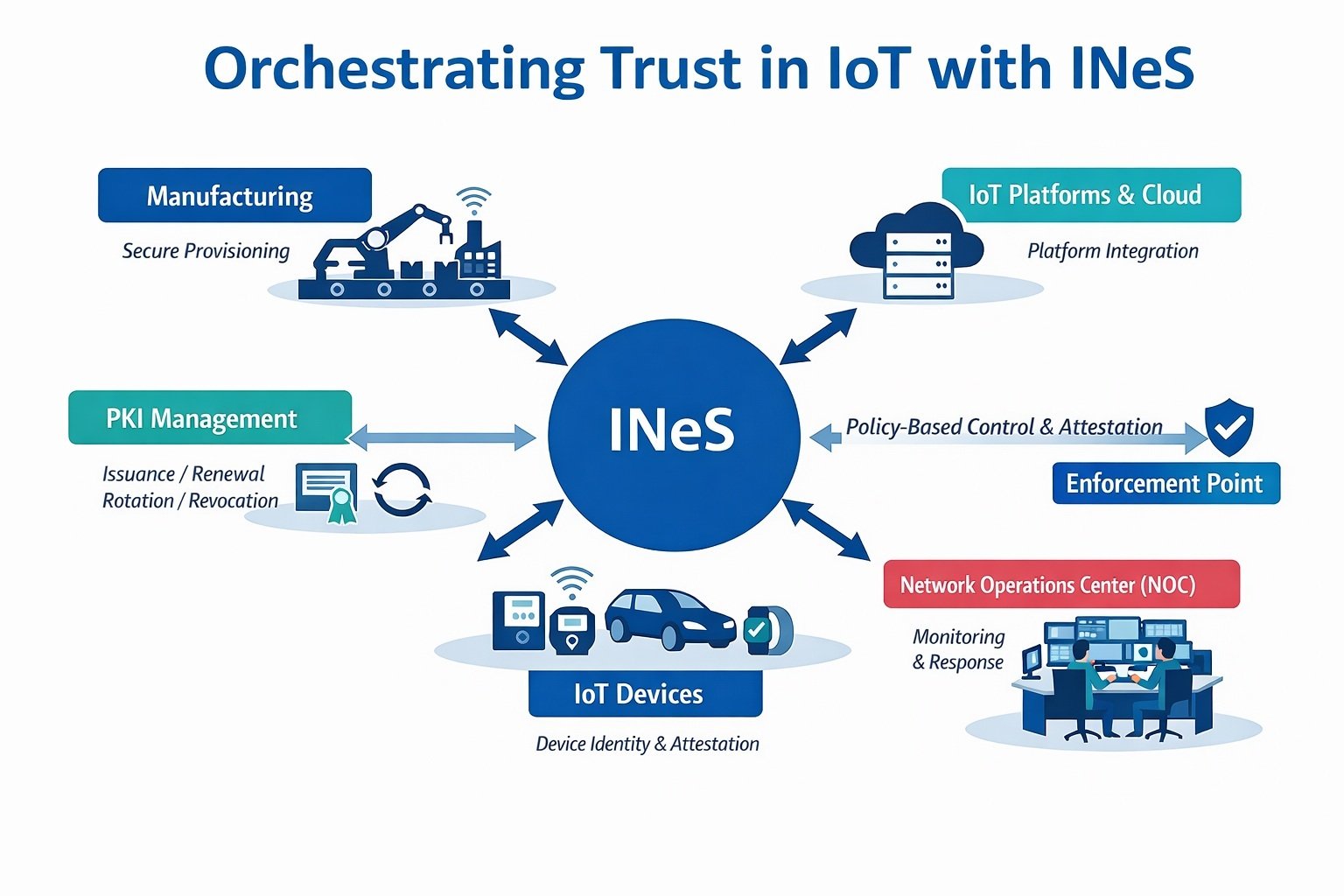
Orchestrating PKI, DAC and Operations with INES
Managing PKI, device attestation, and operational visibility independently creates fragmentation and risk.
INES, developed by SEALSQ, addresses this challenge by orchestrating cryptographic identities, device control mechanisms, and lifecycle governance within a unified platform.
INES enables:
-
Industrial-scale PKI management for IoT devices
-
Policy-driven device attestation and access control
-
Integration with operational environments, including NOC workflows
-
End-to-end lifecycle governance, from manufacturing to decommissioning
By aligning cryptographic trust with operational control, INES allows IoT ecosystems to scale securely, without sacrificing visibility or agility.
From Foundations to Operations: Making Trust Work at Scale
In IoT, trust cannot remain an abstract concept.
It must be verifiable, enforceable, and operable at scale. PKI provides the cryptographic foundation, DAC ensures continuous compliance, and NOC integration turns security into an actionable capability.
As IoT ecosystems grow in size and criticality, platforms that orchestrate these dimensions together will define the next generation of secure, resilient connected infrastructures.