

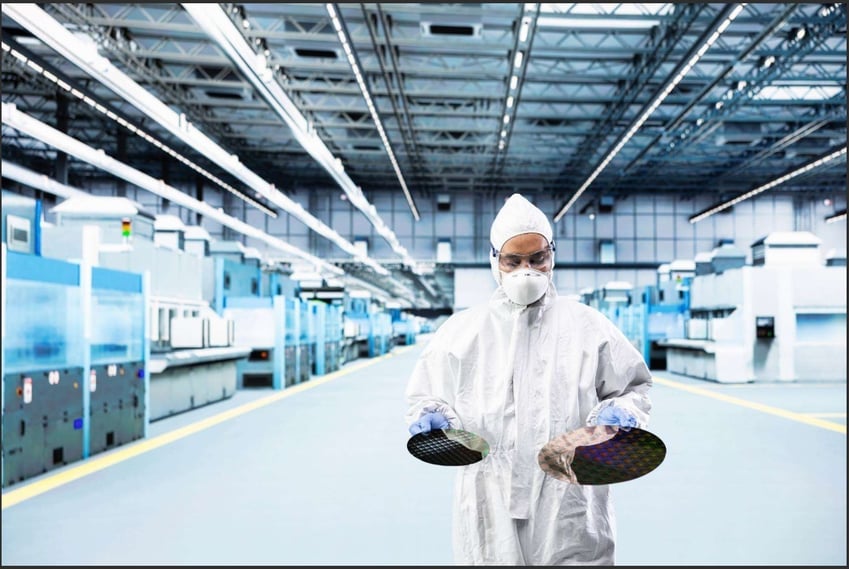
For the past decade, the quantum computing industry has been measured by a familiar set of metrics: qubit count, gate fidelity, coherence times, and error rates. These remain essential indicators of scientific and engineering progress, and recent breakthroughs across the ecosystem continue to demonstrate remarkable momentum.
Yet as the industry matures, a new question is emerging:
How do we transform quantum computing from a collection of promising technologies into an industrial platform capable of supporting real-world applications at scale?
The next phase of quantum computing will not be defined solely by achieving more powerful quantum processors. It will be defined by our collective ability to manufacture, secure, integrate, deploy, and operate quantum systems reliably and economically.
Moving Beyond the Laboratory
History offers many examples of technologies that achieved scientific success long before they achieved commercial success.
The transistor, the integrated circuit, the personal computer, and more recently artificial intelligence all followed a similar path. Breakthroughs in research were merely the beginning. Their transformative impact came only when they could be produced at scale, integrated into larger systems, and deployed reliably across industries.
Quantum computing is approaching a similar inflection point.
Across the industry, we are seeing increasing focus on the infrastructure required to support the transition from experimental systems to production-ready platforms. This shift reflects growing confidence that quantum technologies are steadily progressing toward practical applications in areas such as materials science, pharmaceuticals, optimization, financial modeling, and advanced manufacturing.
But achieving that future requires much more than quantum processors alone.
Quantum Systems Are Semiconductor Systems
A common misconception is that quantum computing is purely a physics challenge.
In reality, scalable quantum computing is increasingly becoming a semiconductor challenge.
As systems grow in complexity, they require sophisticated control electronics, advanced packaging technologies, specialized ASICs, signal processing capabilities, thermal management, and highly optimized interconnect architectures.
Future quantum systems may consist of multiple integrated technologies operating together:
- Quantum processing units (QPUs)
- Cryogenic control electronics
- High-performance classical processors
- Specialized security components
- Advanced chiplet architectures
- Complex packaging and interconnect solutions
This architecture should sound familiar. The semiconductor industry has spent decades solving analogous challenges in high-performance computing, AI acceleration, and advanced system integration.
Many of the capabilities required to bring quantum computing to industrial scale already exist within the broader semiconductor ecosystem.
The opportunity now is to adapt and extend those capabilities for the unique requirements of quantum technologies.
Manufacturing May Become the Ultimate Differentiator
Scientific innovation will remain a prerequisite for success.
However, over time, manufacturing excellence may become just as important as scientific excellence.
Organizations capable of delivering:
- mature fabrication processes,
- repeatable production yields,
- advanced packaging solutions,
- trusted supply chains,
- and long-term manufacturing roadmaps,
will play a critical role in enabling the next generation of quantum platforms.
This is particularly important because future quantum systems are unlikely to be deployed as isolated laboratory instruments. They will need to be produced, maintained, upgraded, tested, and integrated into broader digital infrastructures.
The transition from prototype to platform requires industrial capabilities.
Security Cannot Be an Afterthought
As quantum computing advances, another reality becomes increasingly clear:
The infrastructure supporting quantum technologies must be secure from the outset.
Much attention has rightly focused on the impact quantum computers may eventually have on today's cryptographic systems. This has accelerated the global transition toward Post-Quantum Cryptography (PQC), a critical effort that must continue across governments, enterprises, and critical infrastructure operators.
But there is a second challenge that receives less attention.
As quantum computing platforms become more sophisticated, the underlying infrastructure itself must be protected.
Future quantum ecosystems will require:
- hardware roots of trust,
- secure semiconductor architectures,
- trusted manufacturing processes,
- cryptographic identity management,
- and quantum-resistant security foundations.
Building trust into the infrastructure layer is far easier than attempting to retrofit security later.
The lesson has been learned repeatedly across the digital economy. Quantum computing should benefit from that experience from day one.
Building an Ecosystem, Not a Single Technology
There is unlikely to be a single company, architecture, or technology that defines the future of quantum computing.
Success will depend on collaboration across an ecosystem that includes:
- quantum hardware developers,
- semiconductor manufacturers,
- cybersecurity providers,
- software developers,
- cloud providers,
- and research institutions.
Just as no single innovation created the modern computing industry, no single breakthrough will create the quantum economy.
The leaders of the quantum era will not be defined solely by technical achievements, but by their ability to combine performance, manufacturability, reliability, security, and scalability into deployable, commercially viable platforms.
Through strategic collaborations, including our partnership with GlobalFoundries, SEALSQ is helping advance the semiconductor, cybersecurity, and infrastructure technologies that will underpin the next generation of quantum systems.
The Decade Ahead
The coming years will undoubtedly deliver additional advances in quantum hardware performance. Those developments deserve the attention they receive.
But the industry's most important story may ultimately be broader than any individual technical milestone.
The real challenge is creating the foundations that allow quantum technologies to move beyond research environments and become part of everyday industrial and commercial reality.
That means building the infrastructure, manufacturing capabilities, security frameworks, and semiconductor ecosystems that can support sustained growth.
The future of quantum computing will certainly be shaped by scientific breakthroughs.
But it will be realized through industrialization.
And that journey is only just beginning.